

AEDP Therapy in Vancouver
The feeling you notice first isn't always the whole story.
Find your way through what you feel without having to face it alone.
You know that moment where someone says something seemingly small, and all of a sudden you're knee-deep in a reaction that feels way bigger than you can hold comfortably?
A big feeling rises, followed by guilt. Anxiety swoops in before you've even had a moment to know what you're really anxious about. The moment leaves you wanting to pull away or avoid things altogether, even though another part of you really wants to feel closer. And of course, there's shame that all of this is happening inside you at all.
For one moment, right as everything was amping up, there was an important feeling that became lost in the mix of guilt, anxiety, shame and whatever else surfaced next.
AEDP, or Accelerated Experiential Dynamic Psychotherapy (which we will never expect you to remember or say), is an experiential and relational approach that pays close attention to these moments. Relational and experiential means sessions include paying attention to an emotion, a shift in your body, an impulse to move away, or even something happening between you and your therapist in real time. Accelerated doesn't mean rushed; the name refers to the therapy's focus on working directly with emotional experience and the processes that support change.
Rather than only talking about what happened, or what you remember, you and your therapist slow things down enough to notice what's happening now as you connect to these moments. With another person there to understand your experience more fully, you can build safety and connection that contributes to something new becoming possible. You can make sense of these reactions and move through them together, without them being overwhelming. We tend to the emotions that arise, the ways you protect yourself from them, and what it's like to stay connected to yourself while you feel them. Over time, this means less charge and intensity in your day-to-day life when you experience similar things.
Know you want support but not sure where to start?
Come take your shoes off, curl up with some tea and let’s make a plan. You’re not broken, you’re just wonderfully human, which can be complicated (and sometimes frustrating) to navigate.
Our Find a Counsellor form can guide you in connecting with a counsellor who is the right fit for you.
There's a difference between having an emotion and having a deep knowing of what that emotion is doing here.
Over our lives, we develop ways of responding to emotional experience that make certain feelings easier to access than others. A feeling that once seemed difficult, unsafe, or impossible to express may become surrounded by protection.
For example, you may have learned at a young age that sadness is weak, vulnerable and unacceptable. This experience created anxiety. Now, instead of feeling sad, your system feels anxious right away.
That is part of why anxiety, shame, guilt, numbness, intellectualizing, or withdrawal can show up so quickly and become so familiar you have no idea what it is protecting.
Part of AEDP’s job is to pay close attention to this process.
Emotion isn't always as simple as it seems
-
Defenses are ways of moving away from emotional experience. Some are easy to recognize. Others look completely ordinary: analyzing everything, changing the subject, making a joke, becoming busy, taking care of everyone else, or deciding that something doesn't matter.
-
Anxiety, shame, and guilt can arise in response to another emotional experience.
Anger can be followed almost immediately by shame. Sadness can bring anxiety. Wanting comfort can trigger embarrassment or the belief that you shouldn't need anyone.
The inhibitory emotion is still a real emotional experience. At the same time, it can make it harder to stay connected to the emotion that came before it.
AEDP helps you notice that sequence.
-
AEDP uses the term core emotions for our emotional responses that have evolutionary purpose, such as sadness, anger, fear, joy, excitement, and disgust.
These emotions can tell you something important about what matters, what you need, what you value, or how you are responding to what has happened.
The aim isn't to find one hidden feeling that explains everything. It's to become more able to recognize your emotional experience and move through it with greater capacity.
-
Core emotions exist for a reason. Fear can tell you to move away from danger. Anger can tell you that something needs to change. Sadness can tell you that something mattered enough to grieve, and pulls you towards connection. Each one carries its own instinct for what to do next.
Core emotions can also help you stay connected to what matters. They can tell you when something hurts, when a boundary has been crossed, when you have lost something important, or when there is something you want to move toward.
The goal of AEDP isn't to feel everything all the time. It is to have greater access to the emotional information that helps you understand yourself and respond to your life with more freedom.
-
Inhibitory emotions aren't a malfunction. At some point, anxiety, shame, or guilt may have helped keep a feeling contained when expressing it wasn't safe, possible, or likely to be met well.
While it made sense at one point, the difficulty comes when the same response continues long after the circumstances have changed. What once helped you manage an emotional experience can become the response that arrives automatically, even when you now have more safety, support, or choice.
Counselling through AEDP doesn’t just push the protection away. Instead, we work to meet and understand how these responses have been helping, and create enough safety to explore what has been protected.
-
Feeling an emotion doesn’t mean you need to be consumed or overwhelmed by it.
When an emotion can be experienced in a way that feels tolerable, with enough support and capacity, it can provide knowing that thinking alone cannot always reach. Sadness can make space for grief. Anger can clarify that something mattered or that a boundary has been crossed. Fear can help you recognize danger. Joy, excitement, and connection remind you what is meaningful and alive.
Our counsellors commonly hear the fear that feelings might never end once we let them out. However, the point isn't to hold onto difficult feelings or feel them forever. When emotions are fully felt, rather than interrupted or avoided, they tend to transform into something new. Understanding what emotions are communicating, and letting them move through their natural process, can leave more room for choice, connection, clarity, and a fuller sense of yourself.
-
While it might be a nice idea to imagine, feeling our emotions isn’t a one time thing where we uncover one hidden emotion that explains everything. Unfortunately, emotional experience is more complex than that.
Your time with an AEDP counsellor is about becoming more able to recognize what is happening, compassionately meet the protective responses that have developed, and stay with your emotional experience long enough for something to shift.
A feeling that once led immediately to withdrawal may become an experience you can stay present with. Sadness that was quickly interrupted by anxiety may have room to be felt. Anger that once turned into shame may become clearer as information about what mattered.
As these experiences become more familiar, you can have more freedom in how you respond. The process isn’t simply to feel more or less. It is to have more choice about what happens when you feel.
What does AEDP actually feel like?
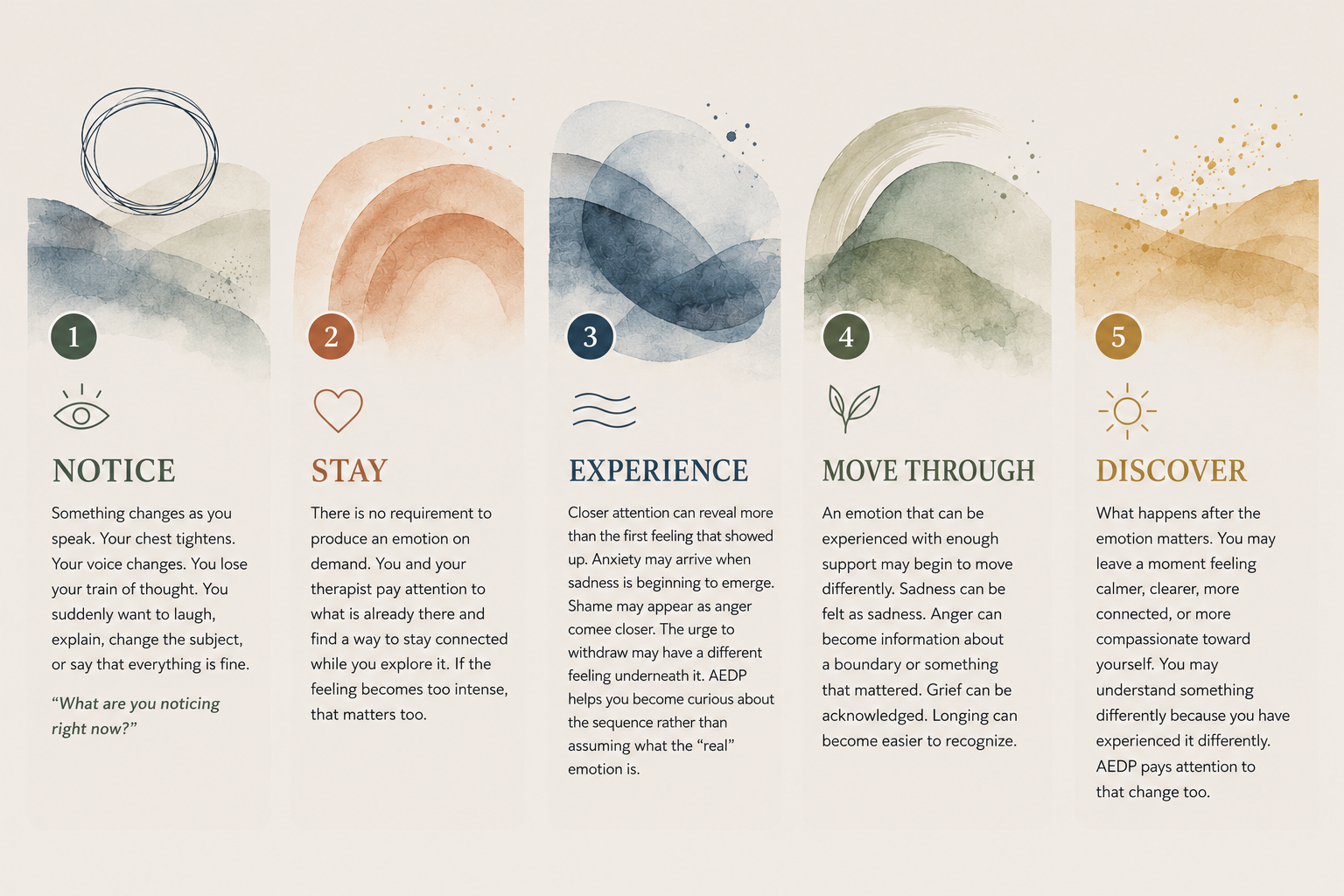
What Becomes Possible
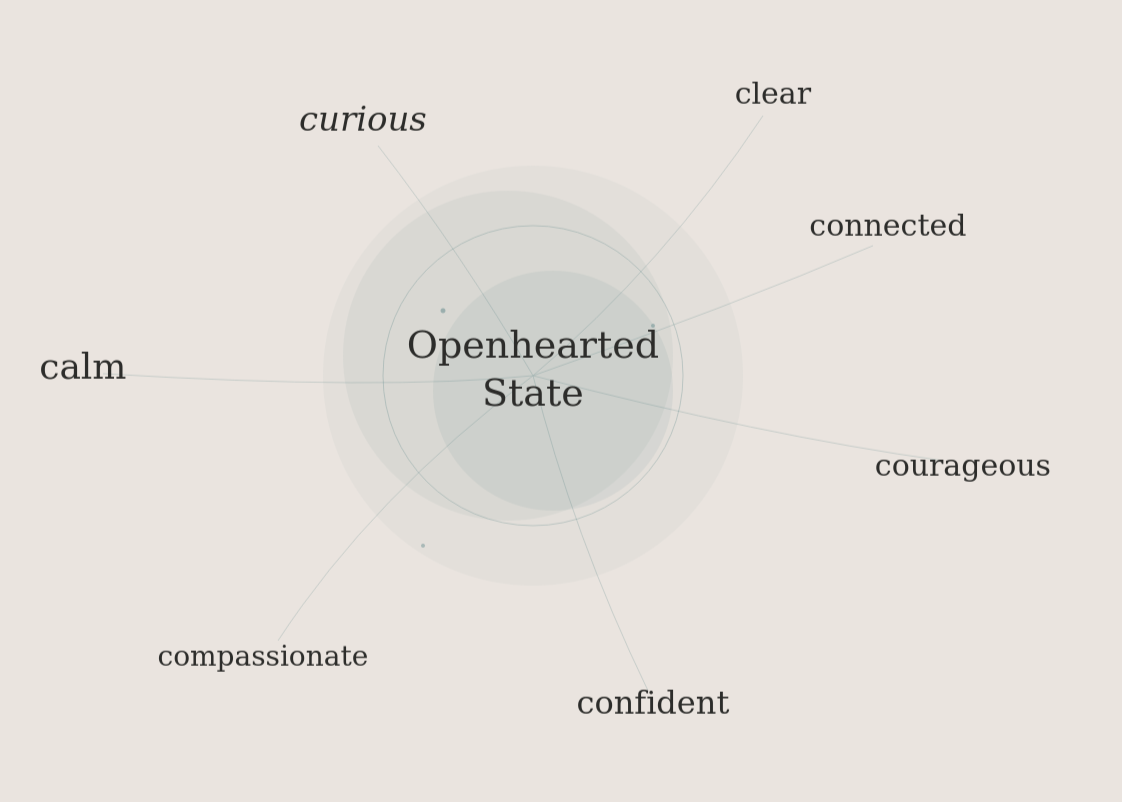
As core emotions are felt and move through, they can transform into what AEDP calls the Openhearted State: a greater sense of calm, curiosity, connection, compassion, confidence, courage, and clarity.
This isn't about feeling good all the time. Life still hurts at times, but the difference is having more access to yourself.

What does an AEDP therapy session sound like?
AEDP can involve very ordinary questions asked at exactly the moment they become useful.
“What are you noticing as you tell me that?”
“Can we slow that down for a moment?”
A therapist may ask these questions when an important emotional shift happens quickly. There doesn't have to be an immediate answer; not knowing is okay and we can notice that too. Emotional awareness and relational safety can take time.
At times the questions are about the relationship that is forming between you and your therapist. An AEDP therapist’s role is to listen to your words and delight in them while paying attention to changes in emotion, body sensations, impulses, protective responses, and the relationship between you.
While it may seem like we are here to analyze everything, we promise that isn’t the point.
We are just here to support you in catching experiences that usually happen too quickly to notice.
These questions bring attention to what is happening now, rather than only the story of what happened then.
“What are you feeling right now?”
What could become possible when you can experience yourself differently?
Our hope is that counselling that integrates AEPD supports you in having more room for experiences of feeling anxious, sad, angry, ashamed, or afraid.
Along the way, you can learn to build emotional awareness, stay connected to yourself even when feelings bubble up, and understand some of the patterns and protective reactions that still might arise from time to time. In time, you may have greater access to the calm, clarity, connection, compassion, courage, and curiosity that can emerge when emotional experience no longer has to be faced alone.
Meet our AEDP Trained Counsellors
The following members of our team have availability for new clients. We offer free 15-minute consultation so you can connect and ask questions first.
We would love to hear from you if AEDP sounds like something you'd like to explore.




AEDP can be worth exploring when emotional experience feels difficult to access, difficult to understand, or difficult to move through.
It can be a good fit when:
Emotions become overwhelming, confusing, or hard to identify
Anxiety, shame, guilt, or self-criticism quickly take over
Shutting down, withdrawing, intellectualizing, or staying busy keeps you disconnected from what you feel
Relationships bring up patterns you would like to understand differently
You want the relationship with your therapist to be part of the work
You want to explore emotions without being pushed beyond what you can manage
You've done therapy before and want a more experiential approach
You want greater access to your own emotional experience
There isn’t just one particular kind of person who connects to or benefits from AEDP. If you recognize yourself in what's described above, one of our counsellors can help figure out together whether this approach fits what you're looking for.
You can arrive with a lot of overwhelming feelings, very little access to feeling, a behaviour or reaction that you’re not loving or simply a sense that something in your life isn't making sense.
Who is AEDP a good fit for?
You make sense, and you’re not alone.
What you’re feeling may make more sense than you think.
All of our counsellors offer a free 15-minute consultation, an exploratory conversation where you can get a sense of who feels like the right fit and we can learn a little about what you are looking for. We want you to find the right person to support you in this important work.
In-person sessions at our Kitsilano clinic (1682 West 7th Ave, Suite 300, Vancouver BC) and online for clients anywhere in British Columbia & beyond.
Frequently Asked Questions About AEDP
-
AEDP stands for Accelerated Experiential Dynamic Psychotherapy. It is an experiential and relational therapy that focuses on emotional experience, the protective responses that can get in its way, and what happens when difficult emotions can be experienced with enough support and connection.
-
No. Talking about feelings can be part of AEDP, but the work also focuses on what is happening as you talk. Your therapist may slow down a moment, ask what you notice in your body, explore a shift in emotion, or pay attention to what is happening between the two of you.
The difference is between describing an emotional experience from a distance and becoming more aware of the experience itself.
-
No. AEDP can be used for many concerns involving emotional experience and relationships. Trauma can be part of the work, but it definitely isn’t the only thing we can focus on.
-
No. AEDP and Emotion-Focused Therapy are different therapeutic approaches, although both place importance on emotional experience.
AEDP has its own framework and places particular emphasis on emotional transformation, defenses and inhibitory emotions, the therapeutic relationship, and what happens in the here-and-now.
-
Not necessarily. AEDP can involve exploring earlier experiences when they are relevant, but the work also pays close attention to what is happening in your life and relationships now.
-
The goal isn't to push you into emotions before you have the capacity to stay with them. If you do feel overwhelmed at any point you can let your counsellor know.
AEDP pays attention to both emotional experience and the protective responses that develop around it. The pace of therapy can respond to what you are experiencing, rather than treating intensity as a sign that the work is going well.
RCC, She/Her
Esther supports clients with self-worth, relationships, attachment, childhood experiences, neurodivergence, family dynamics and burnout, creating space for clients to better understand themselves and the patterns shaping their lives. Esther also has a background as teacher and school counsellor and loves supporting teens, other educators, caregivers and those with BIPOC experiences or who have lived outside of Canada
Main Approaches:Somatic · Mindfulness · Attachment-Focused · IFS · Narrative · DBT · Emotion-Focused · AEDP